A QSR site selection checklist is a set of 10 physical, market and legal checks a quick-service operator runs before committing to a location. It covers access, drive-thru capacity, traffic, visibility, demographics, competition, zoning and the lease itself. Most failed QSR sites fail on access or stacking, not on population.
Why off-premises traffic changes the checklist
The National Restaurant Association's 2025 Off-Premises Restaurant Trends report found that nearly 75% of restaurant traffic now happens off-premises, through takeout, drive-thru and delivery. For a quick-service concept, the parking lot, the drive-thru lane and the pickup area now do more work than the dining room.
So a good QSR site today is judged by how fast a car can get in, order, collect and leave. Dining room size comes second.
The 10-point QSR site checklist
| # | Check | What good looks like | Red flag |
|---|---|---|---|
| 1 | Ingress and egress | Full access from the main road, ideally at a signalized intersection | Right-in, right-out only on the side of the road you need |
| 2 | Drive-thru stacking | Lane room for your brand's required queue without blocking the lot | Queue spills onto the street or into parking aisles |
| 3 | Traffic counts | Counts that meet your franchisor's minimum, on the right side of the road | High counts on a road with a median you can't cross |
| 4 | Visibility | Building and pylon visible to drivers with time to turn | Sign blocked by trees, other pylons or a grade change |
| 5 | Daypart fit | Traffic pattern matches your peak, such as morning commute for breakfast | Your peak runs against the commuter flow |
| 6 | Trade area demographics | Population, daytime workers and income inside your drive time | Strong residential numbers but no lunch crowd |
| 7 | Competition and co-tenants | Nearby generators like schools, offices, grocery or big-box stores | A direct competitor with a better access point next door |
| 8 | Zoning and permits | Drive-thru allowed by right | Drive-thru needs a special use permit with a hearing |
| 9 | Utilities and site work | Grease trap, gas and sewer capacity in place | Large off-site utility or road work required |
| 10 | Lease protections | Exclusive use, co-tenancy if in a center, permit contingency | No way out if permits fail |
The checks that kill the most deals
Access and stacking (checks 1 and 2)
Look at the site from a driver's seat at your peak hour, not on a map. Count how many cars the drive-thru lane can hold before it backs into the lot. Your franchisor will usually have a minimum stacking requirement, so get it before you tour.
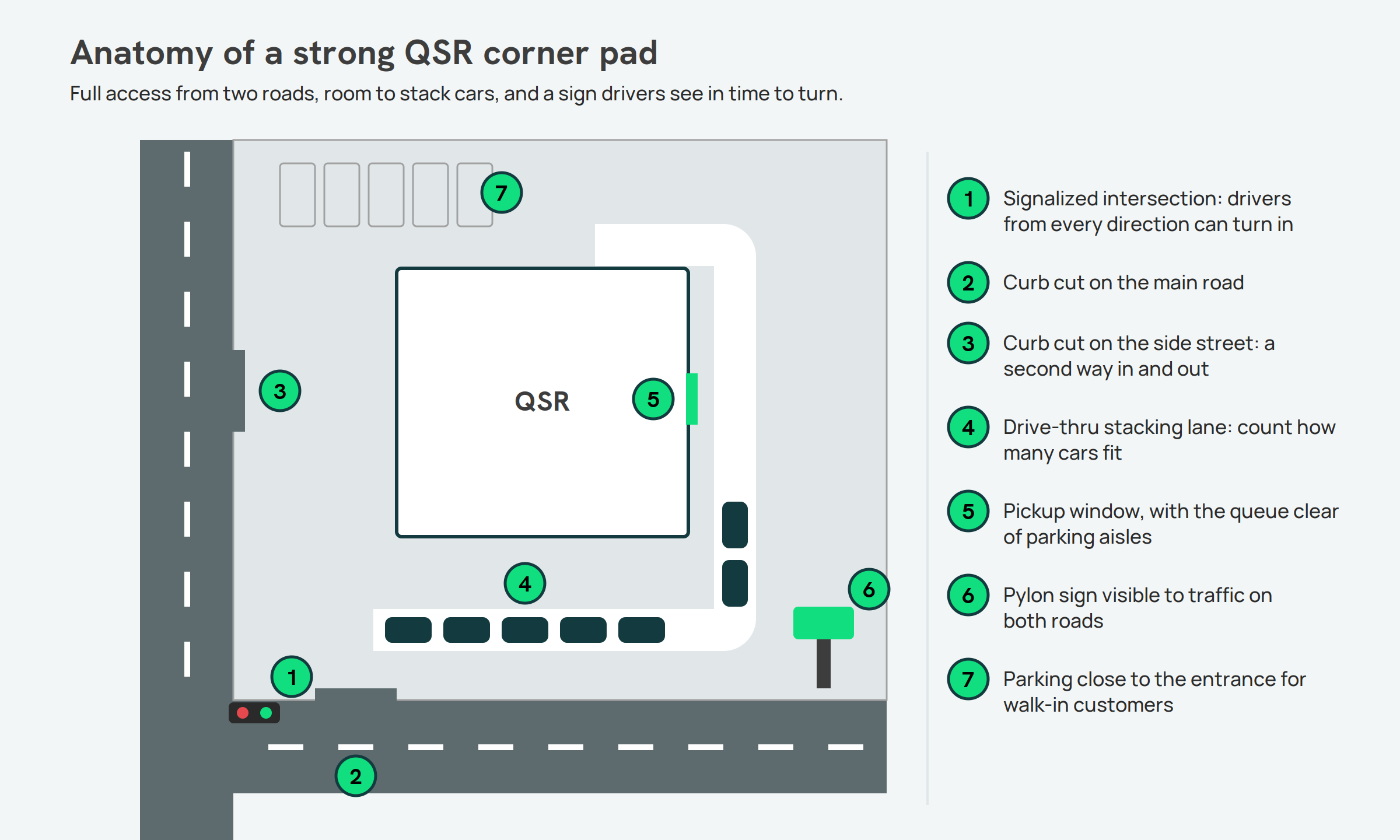
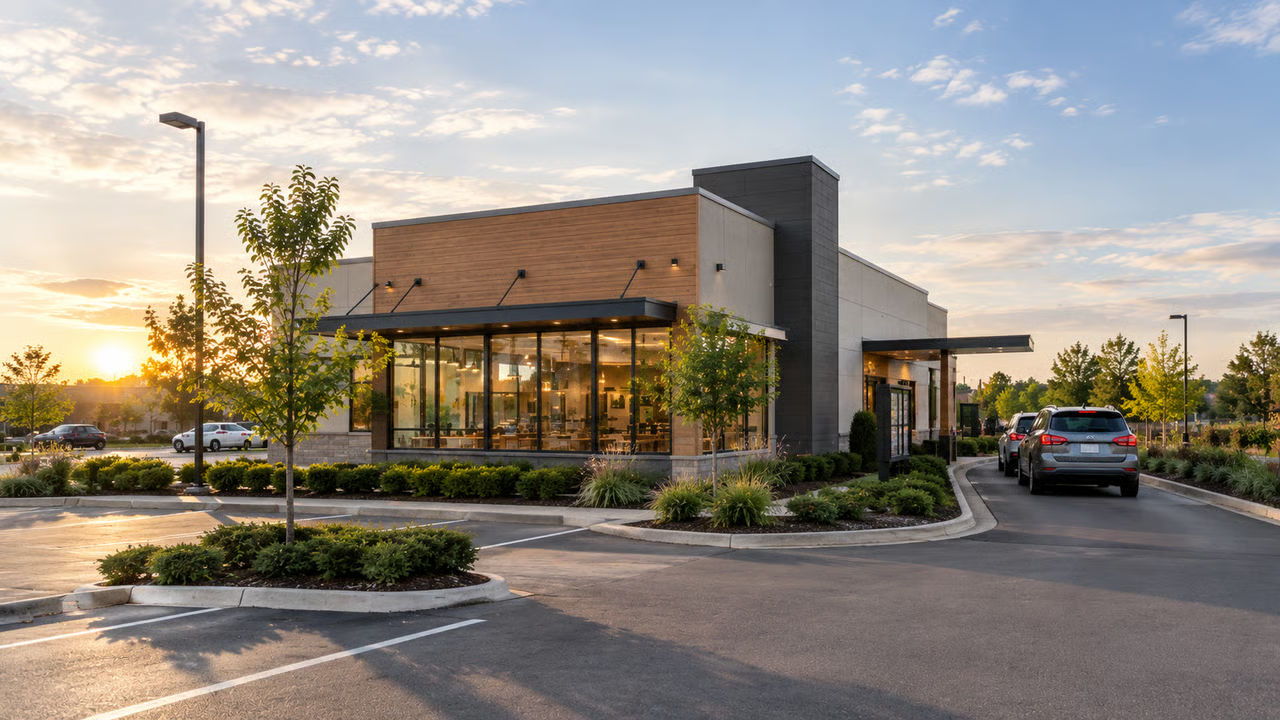
A corner pad at a signal, like the one in the plan above, gives drivers from both directions a way in and out. A mid-block site with one curb cut and a median in front of it can cut your potential customers in half, whatever the traffic count says.
Traffic counts (check 3)
State departments of transportation publish annual average daily traffic counts for major roads, and the Federal Highway Administration links to them. Treat the number as a starting point. Ask which side of the road it measures and whether a median blocks left turns into your site.
Zoning (check 8)
Many municipalities restrict new drive-thrus or require a public hearing. A hearing adds months and can end in a no. Call the planning department before you sign an LOI and ask whether a drive-thru is permitted by right on that parcel.
Use your franchisor, then check their work
If you're a franchisee, your Franchise Disclosure Document describes what site selection help the franchisor provides and what territory protection you get, as required by the FTC Franchise Rule. Many franchisors approve sites against their own criteria. Approval means the site meets their minimums. It doesn't mean the site is good for you.
Our view: run this checklist yourself even after franchisor approval. The franchisor's model covers the brand's average store. You're signing for one specific corner, for 10 to 20 years.
Lease terms that protect a QSR site
Even a strong site needs lease protection. Ask for an exclusive use clause that bars a direct competitor in the same center, a permit contingency, drive-thru and signage rights written into the lease, and, in an anchored center, a co-tenancy clause tied to the anchor that drives your traffic. Review the rest with a commercial lease review checklist.
Waltre lets franchisees and multi-unit operators post requirements once, with their drive-thru, size and traffic criteria, and verified landlords and brokers bring sites that match. You spend your time touring sites that pass the first few checks, not ruling out ones that never could.
Sit in the parking lot at lunch before you sign. It tells you more than any report.
Frequently Asked Questions
What should I look for in a QSR location?
Start with access and drive-thru stacking, then traffic counts, visibility, daypart fit, trade area demographics, competition, zoning, utilities and lease protections. Access problems sink more QSR sites than weak demographics.
How many cars should a drive-thru stack?
It depends on the brand and its peak volume. Most franchisors set a minimum stacking requirement, so get that number before touring sites and measure each lane against it.
Where can I find traffic counts for a site?
State departments of transportation publish annual average daily traffic counts for major roads, and the Federal Highway Administration links to them. Check which side of the road the count measures.
Does franchisor site approval mean a location is good?
It means the site meets the franchisor's minimum criteria. You should still check access, stacking, zoning and lease terms yourself, because you carry the lease.
Do drive-thrus need special zoning approval?
In many municipalities, yes. Some allow drive-thrus only with a special or conditional use permit, so confirm with the planning department before signing an LOI and make the lease contingent on approval.