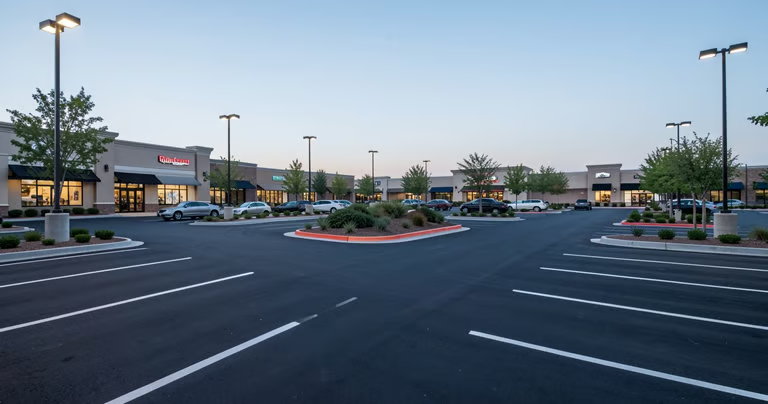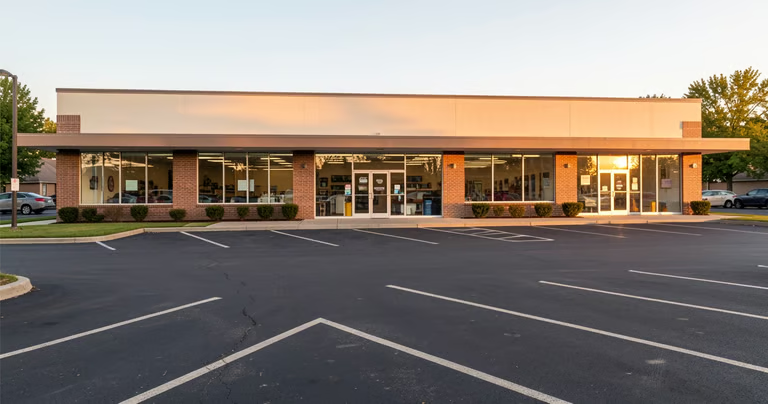
A co-tenancy clause is a retail lease provision that lowers your rent, or lets you leave, if named anchors close or a shopping center's occupancy drops below a set level, such as 70%. It protects you from paying full rent for traffic that's gone. Opening co-tenancy applies before you open. Operating co-tenancy applies afterward.
Why co-tenancy matters right now
Small-shop tenants in a center pay rent partly for the traffic the anchors bring. When an anchor closes, that traffic can fall fast while the rent stays the same.
It's happening in parts of the market today. In Q2 2026, neighborhood, community and strip centers posted negative net absorption for the first time since Q2 2025, according to CBRE data reported by Chain Store Age, driven by apparel boutique closures and fewer bank branches. National retail availability was a low 4.9%, but a tight national number doesn't help you if the grocery store next door closes.
Opening vs operating co-tenancy
| Opening co-tenancy | Operating co-tenancy | |
|---|---|---|
| When it applies | Before you open | During the lease term |
| Typical trigger | Named anchors or a set % of the center not open on your opening date | Named anchor closes, or occupancy falls below a set % |
| Typical remedy | Delay opening without penalty, or open and pay reduced rent | Reduced or alternative rent for a set period |
| If it isn't cured | Right to terminate | Right to terminate, often after 12 to 24 months |
Alternative rent is often a percentage of your gross sales, sometimes with a floor, paid instead of base rent until the problem is fixed.
Three scenarios that show how it works
Scenario 1: the anchor never opens
You sign in a new center anchored by a grocery store and a fitness center. The grocery store's opening slips by eight months. With an opening co-tenancy clause, you can delay your own opening without paying rent, or open early at reduced rent until the anchor arrives. Without one, you're paying full rent to sit next to a construction fence.
Scenario 2: the anchor goes dark mid-lease
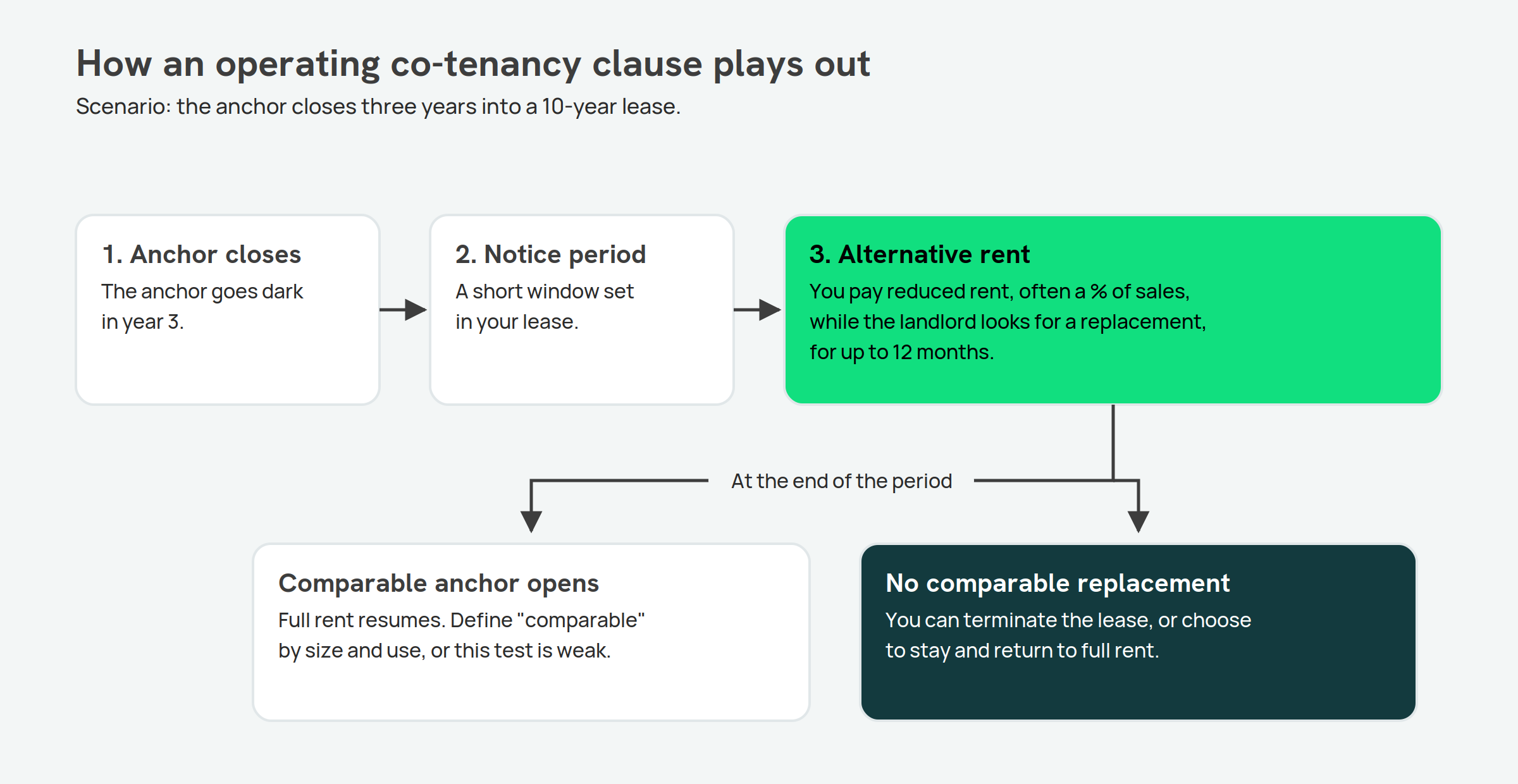
Three years into a 10-year lease, the big-box anchor closes. Your operating co-tenancy clause kicks in after a short notice period. You switch to alternative rent for up to 12 months while the landlord finds a replacement. If no comparable anchor opens by then, you can terminate.
The friction is the word "comparable." If the lease just says "a replacement tenant," the landlord can fill the box with a use that brings little of the same traffic. Define a replacement by size, use category, or both.
Scenario 3: occupancy slowly drains
No single closure, but over two years the center drops from 90% occupied to 65%. A clause tied only to named anchors does nothing here. A clause with an occupancy threshold, such as 70% of the center's gross leasable area open and operating, protects you. Ask how the threshold is measured. Some landlords count space that's leased but closed, or count temporary pop-ups and seasonal tenants. Others exclude outparcels, which can make the percentage easier or harder to hit. The definition decides whether the clause ever triggers.
What landlords push back on, and why
Landlords dislike co-tenancy because one anchor closure can trigger reduced rent across many tenants at once, and lenders look hard at it when they value the property. Expect resistance on:
- Termination rights, which landlords try to limit or delay
- Occupancy thresholds, which they prefer to set low
- How long alternative rent lasts before you must choose to stay at full rent or leave
Some leases also add a sales test, where the remedy only applies if your sales actually fell after the closure. Push back on that one. Proving cause from sales data is slow and invites disputes.
Our view: for any retailer or restaurant whose sales depend on an anchor's traffic, a co-tenancy clause is worth giving up something else to get. A slightly higher rent with real co-tenancy protection beats a lower rent with none.
Co-tenancy works best alongside two other clauses
Co-tenancy protects you when traffic leaves. Two other clauses protect you from traffic being split.
An exclusive use clause stops the landlord from leasing to a direct competitor in the same center. It's the clause most small tenants ask for first, and landlords grant it more readily than co-tenancy because it costs them less. Write it narrowly enough that the landlord can accept it and broadly enough that it covers your real competitors. "Coffee as a primary use" protects a cafe better than "coffee shop."
A radius clause usually runs the other way. Landlords use it to stop you opening another location within a set distance, so your sales at their center aren't diluted. If you plan to grow in the area, negotiate the distance down or carve out locations you already operate.
Read the three clauses together. A strong co-tenancy clause in a center where the landlord can lease next door to your competitor still leaves you exposed.
How to negotiate a co-tenancy clause that holds up
- Name the anchors. List the specific tenants or define them by size and use.
- Add an occupancy test. Cover the slow drain, not just one closure.
- Define "operating." Open to the public, for normal hours, in most of its space. A dark store still paying rent shouldn't count.
- Set a clear cure period and what happens when it ends.
- Make sure alternative rent is lower than base rent, not a formula that can come out higher.
Raise co-tenancy in the LOI, not the lease draft. Our guide to writing a commercial lease LOI covers how. If you're a quick-service operator, combine it with the checks in our QSR site selection checklist.
Waltre lets retailers and franchise operators post a requirement and hear from verified landlords and brokers with matching space, including space in centers that haven't been publicly marketed. Ask every landlord for the center's tenant roster and lease terms of its anchors before you compare offers.
Your rent depends on your neighbors. Protect it in writing.
Frequently Asked Questions
What is a co-tenancy clause?
A co-tenancy clause is a retail lease provision that gives a tenant reduced rent or a right to terminate if named anchors or a set share of the shopping center stop operating.
What is the difference between opening and operating co-tenancy?
Opening co-tenancy applies before you open and covers anchors or occupancy levels that must be in place on your opening date. Operating co-tenancy applies during the term and covers anchors that close or occupancy that falls later.
What is alternative rent in a co-tenancy clause?
Alternative rent is a reduced payment, often a percentage of your gross sales, that replaces base rent while a co-tenancy failure continues. It usually lasts for a set period before you must choose to pay full rent or terminate.
Can small tenants get co-tenancy clauses?
It's harder than for national retailers, but possible, especially in new centers or ones with vacancy. Ask during the LOI and be ready to trade something, such as a longer term.
Does a dark anchor that still pays rent trigger co-tenancy?
Only if the clause requires the anchor to be open and operating, not just leased. Define operating as open to the public for normal business hours.