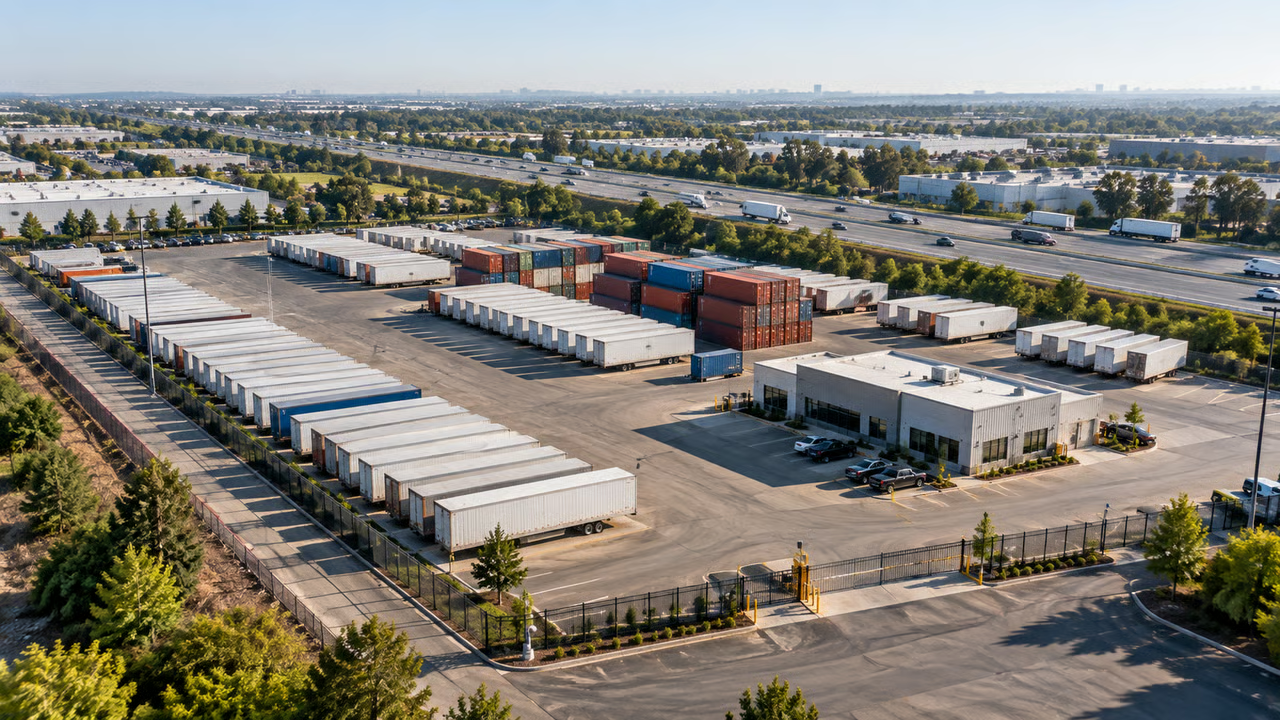
Industrial outdoor storage (IOS) is industrial land used mainly for open-air storage and parking, usually with a small building or none at all. Trucking fleets, equipment rental firms, contractors and 3PLs use it for trailers, containers, vehicles and materials. In Q4 2025, IOS vacancy was 2.5%, compared with 6.7% for traditional industrial property.
IOS by the numbers
| Measure | Figure | Source and date |
|---|---|---|
| Average IOS rent | $13.14 per sq ft, about 18% above traditional industrial | KBRA, September 2026, Q4 2025 data |
| IOS vacancy | 2.5% vs 6.7% for traditional industrial | KBRA, Q4 2025 data |
| Rent growth since 2020 | 123%, vs 58% for bulk warehouse | Newmark, reported June 2026 |
| Estimated U.S. IOS land | 1.4 million acres | Newmark, reported June 2026 |
| Market rent above in-place rent | 29.8% | CompStak, Q1 2026 |
| Institutional share of acquisitions | Estimated 35% to 45%, up from 25% to 30% four years earlier | KBRA, September 2026 |
Two of those numbers matter most for leasing. Vacancy at 2.5% means tenants have few options in most markets. And the 29.8% gap between market and in-place rent means many IOS tenants are paying well under today's rate, so renewals will bring large increases.
What counts as an IOS site
IOS is an umbrella term. Sites vary a lot, and they suit different tenants:
- Truck and trailer parking. Paved or gravel lots near highways and ports, often with a small dispatch office.
- Equipment and contractor yards. Space for machinery and materials, sometimes with a maintenance shop.
- Container storage and staging near ports, rail yards and distribution hubs.
- Fleet parking for utilities, telecom and service companies.
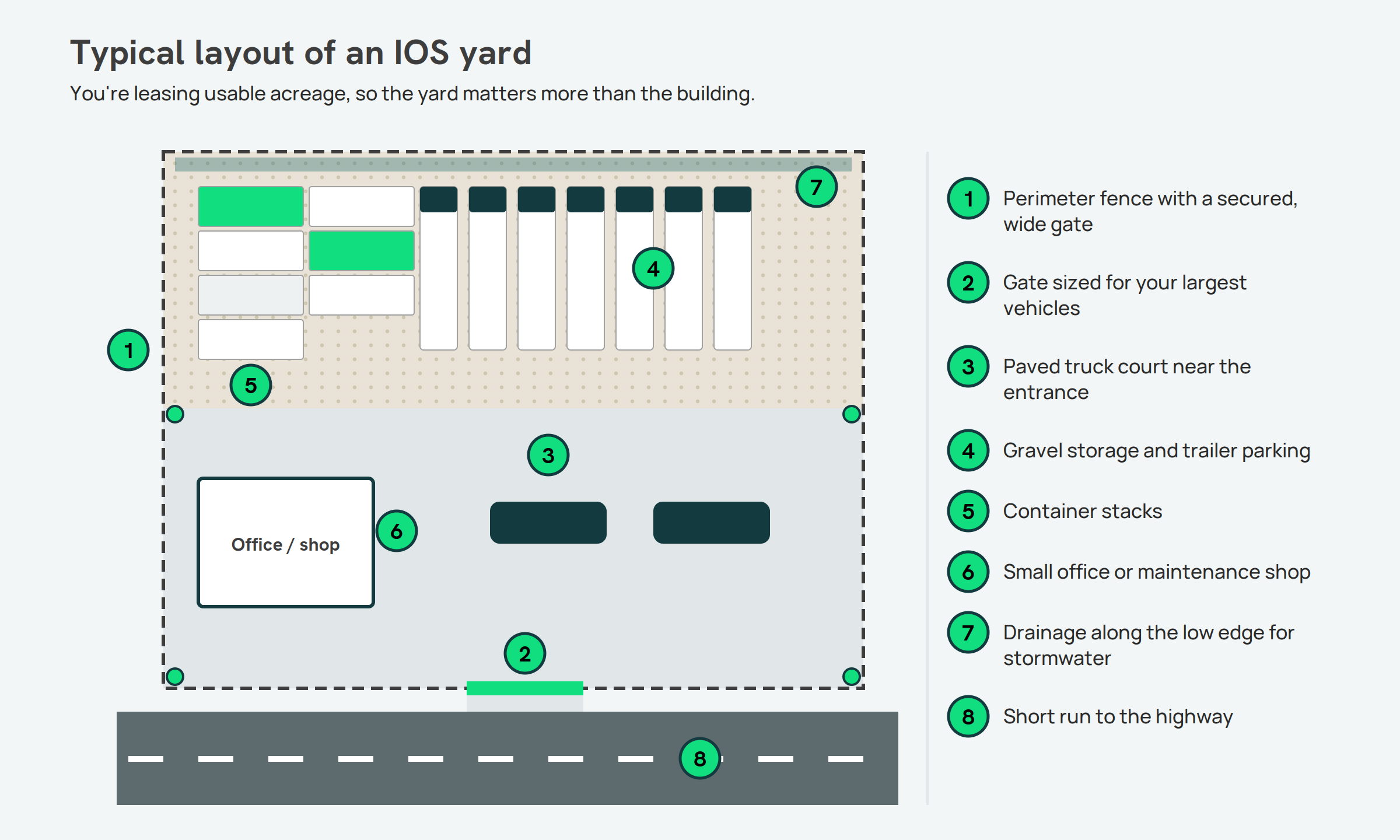
What they share is a low ratio of building to land. You're leasing usable acreage, so the quality of the yard matters more than the building.
Why supply stays tight
New IOS is hard to build. KBRA's report points to zoning limits, local opposition to outdoor storage and truck traffic, and a shortage of well-located industrial land. Many municipalities restrict new outdoor storage uses, and some neighbors push back hard against truck traffic.
That's why rents keep rising even as the wider industrial market has cooled. Demand from logistics, domestic manufacturing and infrastructure work keeps coming, and new supply can't keep pace.
What tenants should check before leasing IOS
- Zoning for your exact use. Truck parking, container storage and equipment repair can fall under different categories. Confirm your use is permitted by right, not just "industrial."
- Surface and drainage. Paved, gravel or dirt changes what equipment the lot can carry and what stormwater rules apply. Ask who maintains the surface.
- Access. Check turning radii for your largest vehicles, gate width, and distance to the highway. A site 10 minutes farther out can cost more in fuel and driver time than it saves in rent.
- Security. Fencing, lighting, cameras and controlled gates. Equipment theft is a real cost.
- Environmental condition. Prior fuel storage, repairs or spills can leave contamination. Ask for any Phase I environmental site assessment and make sure the lease doesn't make you liable for conditions that existed before you arrived.
The friction most tenants hit is the environmental clause. Landlords often ask the tenant to restore the site to its original condition at lease end. Without a baseline report at move-in, you can't prove what was already there.
How IOS leases differ from warehouse leases
An IOS lease looks more like a land lease than a warehouse lease. Expect these differences.
Rent is often quoted per acre per month, or per square foot of land, rather than per square foot of building. When you compare a yard with a warehouse-plus-yard, convert both to the same basis.
Terms tend to be shorter. Owners holding land for future development often prefer a few years at a time, and many operators like the flexibility. The trade-off is renewal risk: with market rents running about 30% above in-place rents, according to CompStak, a short term means a bigger reset sooner.
The tenant usually maintains more. Surface repairs, fencing, gates and lighting often fall to you. Negotiate who pays for improvements you need on day one, such as extra lighting or a paved section for heavy equipment, and whether you can remove them at the end.
Insurance and environmental terms carry more weight than in a warehouse lease, because fuel, fluids and heavy equipment sit outdoors on the ground. Expect the landlord to ask for higher coverage and an environmental indemnity. Ask for that indemnity to cover only conditions you caused.
What landlords should know
For owners, IOS can be a strong use for land that's waiting for redevelopment or too small for a warehouse. Our view: owners holding underused industrial land should look hard at IOS leases now. Demand is high, the use needs limited capital, and shorter IOS lease terms keep your redevelopment options open.
Watch your own risks too. A tenant's operations can create environmental issues, and zoning can restrict your ability to re-lease to a similar user later. Require insurance, a baseline environmental report and clear restoration terms. If a yard is empty today, the steps in our playbook for cutting vacancy downtime apply to land as much as to buildings, especially reaching tenants who are already looking. Our tenant scorecard for landlords covers the rest of tenant due diligence.
Finding IOS space when there's almost none listed
With vacancy this low, many IOS sites lease before they're marketed. Waltre lets operators post an IOS requirement once, with acreage, surface, access and zoning needs, and verified landlords and brokers bring matching sites, including off-market land.
Move early on IOS. Good yards don't sit.
Frequently Asked Questions
What is industrial outdoor storage?
Industrial outdoor storage, or IOS, is industrial land used mainly for open-air storage and parking of trucks, trailers, containers, equipment and materials, usually with a small building or none.
Why is IOS so expensive right now?
Demand from logistics, manufacturing and infrastructure work is high, while zoning limits, local opposition and a shortage of industrial land make new IOS hard to build. KBRA reported IOS vacancy of 2.5% in Q4 2025.
Who leases industrial outdoor storage?
Trucking companies, 3PLs, equipment rental firms, contractors, utilities and telecom companies, and businesses that need container or materials storage near ports and highways.
How is IOS rent quoted?
IOS rent is often quoted per acre per month or per square foot of land, depending on the market and the broker. Compare offers on the same basis and check what's included, such as paving, lighting and security.
Do I need an environmental assessment for an IOS lease?
It's strongly advisable. A Phase I environmental site assessment, or at least a baseline report at move-in, protects you from being blamed for contamination that existed before your lease.